![Perfect Words #1: Arete [ἀρετή]](https://cecileblanc.com/wp-content/uploads/2025/12/img20250316122329-1.jpg?w=1200)
One of the reasons I love writing is that I get a real kick out of finding the “perfect word”: when you discuss a concept and someone sums it up into one word, with the right level of strength, even the right sounds that fit its meaning like “furious” or “awe”.
Sometimes these moments can capture meaning, like a photographer snatching a fleeting moment: how the light landed, how it made them feel.

Sometimes they can instead create meaning: when someone frames a concept for you with a new word, be it made up, borrowed from an other language, or simply unexpected.
There was such a moment earlier this week, as photographer Chris Mann and myself were discussing art over coffee, and I got to dust off the ancient Greek concept of Arete from my student years.
Specifically, we were debating the risks and rewards of dedicating time to art. The risk being financial, the reward being Arete.
‘Arete’ is a perfect word because it blends and elevates competence and gift. Its initial meaning is the “fulfilment of purpose or function”, for example a good, sharp knife fulfilling its cutting function, a pianist who took their gift and honed it with practice to become the best pianist they can be, or simply for any of us to “live well or excellently the life that we have“.
What is funny is that I had forgotten about that word but since that conversation I see Arete everywhere.
Yesterday I was taken aside by the swimming coach, as my son was not listening. I already covered in Desapego (another perfect word!) the specific agony of taking your neurodiverse kids to sports activities so will cut directly here to what happened next: instead of complaining, she asked me for tips to get his attention, went back to him and from then on he was focused and dedicated.
It was great to see him do his best but what moved me as I observed the rest of the lesson was to watch the coach work: how she showed the movements to the kids, how she stretched them and rewarded them. It was Arete: she was clearly doing what she was meant to do, with a gift perhaps, supplemented by experience, competence, excellence.
Looking back, I realised that witnessing Arete is one of my favourite things in life: when I saw my friend, composer Raphaelle Thibaut, record at Abbey Road Studios, and snapped this picture to remember how it felt to see her there, the boss in the room, years after she suddenly quit her job at Google because she just had to make music.
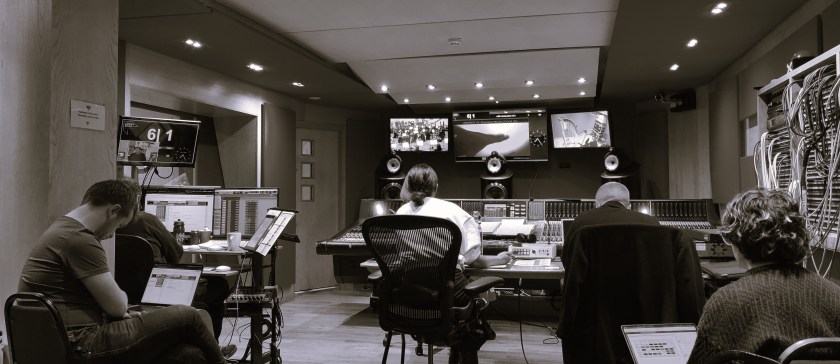
Even earlier this year in the middle of a session with Dina Grishin – the career coach who recently helped me – when I told her how happy I was that she had left her old job and decided to pursue coaching. It did not make me happy for her, mind you, or even for myself, who got to enjoy the fruit of her labour. It simply satisfied me tremendously to witness her do what she was obviously meant to do.
So there you go: look around you and take a little mental snapshot every time you notice Arete. Your barista who makes an excellent coffee. The notebook whose weight, texture and dimensions are just right. The teacher that all the kids in school love somehow. Yourself, as you feel in your chest that odd mix of rush and calm when you are in the flow, doing what you are meant to be doing.
In between weird nail art and outrage bait, the algorithm recently pushed me this video of Tom Waits reading Bukowski’s poem The Laughing Heart, which captures in so many words the essence of this indulgent digression, and is therefore probably the most elegant way to wrap it up.
 Cecile H. Blanc