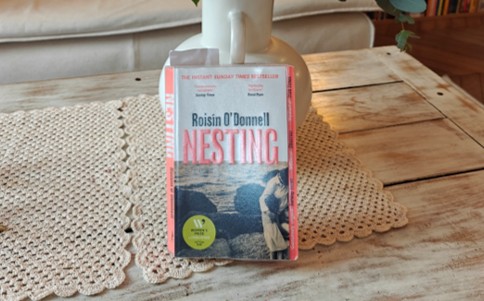
Nesting by Roisín O’Donnell

I haven’t yet recovered from Nesting, Roisín O’Donnell‘s fantastic debut novel. It still sits in my chest, not yet digested.

In a few words, Nesting is the story of Ciara Fay, mother of two, pregnant with a third, who decides one day to leave her controlling husband.

From the first scene, as he insists on taking the girls swimming in the freezing sea, we follow Ciara’s precarious balancing act – indulging him, protecting them – and it’s impossible not to root for her.

O’Donnell masterfully executes the “escape” – we have no choice but to feverishly turn the pages, hoping they make it, that he doesn’t catch them. By the time they fall asleep in the car, surrounded by nature, and wake up in the morning mist, we are so invested that it is very clear this novel will be devoured.

The language humbly serves the main character and the story, but in several places it is clear that it is also worth reading for its own sake. This is after all the story of a woman reclaiming her voice, an English teacher who travelled the world before waking up one day married, pregnant, and stuck in a very small world.
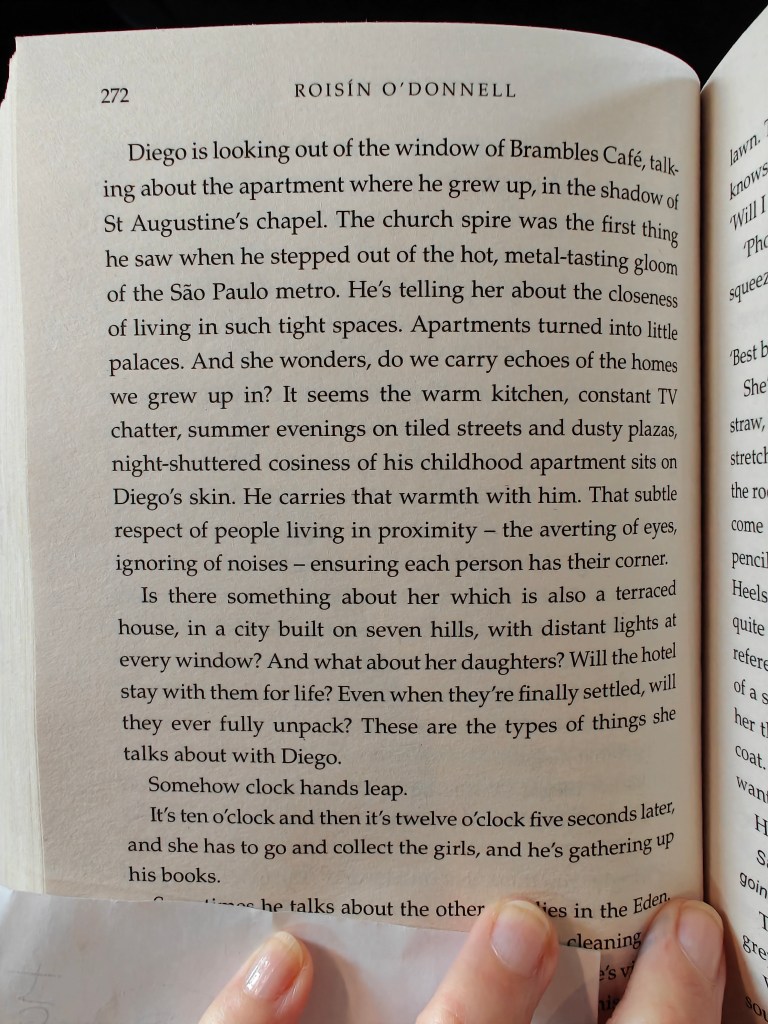
Nesting extract

That small world is treated with immense dignity. All the little tasks of motherhood, the struggles of parenting with very little money, of rebuilding a home in a hotel room, are rendered with rough immediacy, without ever tipping over into voyeuristic miserabilism.

The characters that enter and expand Ciara’s world in the “Eden” hotel all feel real. So do her relationships with her mother and sister, and each obstacle she needs to overcome. The husband is perhaps too one dimensional at times – almost as if rather than being a proper character, he was a representation of something bigger and rather ugly.

The theme of birds is nicely weaved into the story. The lone crow symbolising both the husband’s ferocity and Ciara’s emancipation. Sophie’s fierce insistence on holding the falcon. Ciara’s mother’s knowledge of birds and their songs. It offers Nesting a coherent imagery, without ever feeling heavy handed.

I have read this book quickly – in the train, before bed, waiting in line in the bathroom. Needing to reach that final page, to know what would happen to them in the end. I know I will read it again eventually, to fully appreciate the care and craft that went into it.

Finally, in a world where AI likes to pretend it can fill our inspiration cup like real authors can, I very much appreciated O’Donnell’s final dedication. It matters to me that she cares, and I can’t wait to read everything else she writes.

To anyone trapped in a place that does not feel like home, to anyone who has ever been asked the question, why don’t you just leave, this one’s for you.

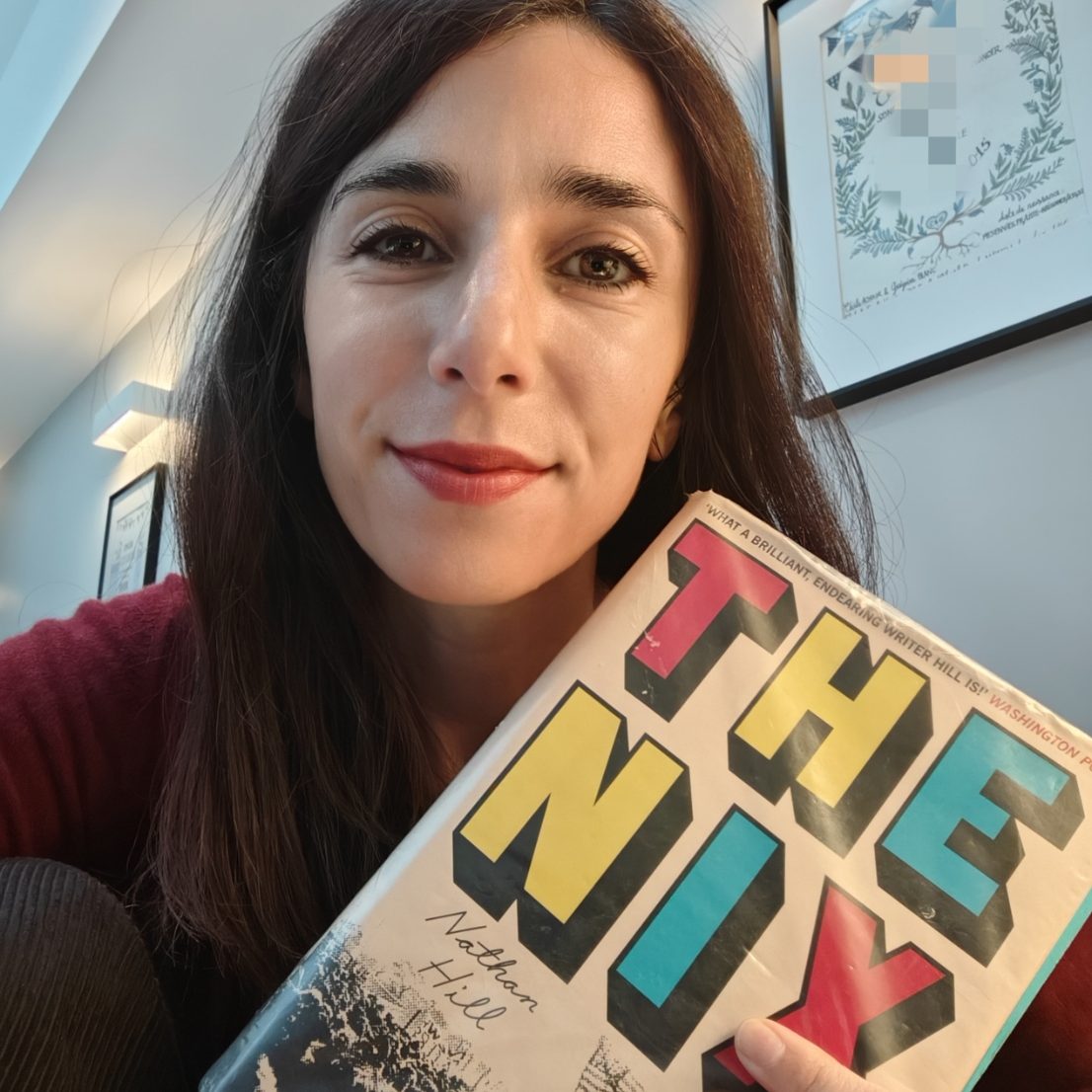
Book Review – The Nix by Nathan Hill

I ordered The Nix from my library after a friend recommended it this summer, and fell in love with the voice straight away: erudite and witty, with the best prologue I have read in a while, and a devastating first sentence:

If Samuel had known his mother was leaving, he might have paid more attention.

The prose in Nathan Hill’s impressive debut novel is sneaky. The language is delicious and reads easily. Humour softens us up. Then daggers are planted deep in our hearts.

As a mother of boys, I find the chronic misunderstanding between the main character Samuel and his mother triggering – and cried like a baby at the end of the first chapter of Part Two:

“And I told you to bring nine toys,” she said. “You brought eight. Next time try to pay more attention.” And the disappointment in her voice made him cry even harder, so that he couldn’t talk, and thus he couldn’t tell her that he put eight toys in the wagon because the ninth toy was the wagon itself.

The story starts when the mother becomes a viral sensation for throwing rocks at a presidential candidate, and the son she abandoned as a child is coerced by his publisher into writing a sensational ‘tell-all’ book about her. As he investigates her past, family secrets are unveiled and old wounds are healed.

It’s a book from a decade ago, but very relevant to today’s tired gender wars, where men and women are expected to keep competing in a never-ending zero sum game where the only winners are those who fan the flames of outrage for social media engagement – and even traditional publishers like The New York Times and The Guardian are taking the (click-)bait.

This makes reading Nathan Hill’s novel now all the more poignant, and imbues the turtle anecdote – which I can’t resist sharing here – with new meaning: perhaps we can emulate Samuel’s journey and build new bridges, rather than widening the gap generation after generation.

Years later, in a high-school biology class, Samuel heard a story about a certain kind of African turtle that swam across the ocean to lay its eggs in South America. Scientists could find no reason for the enormous trip. Why did the turtles do it? The leading theory was that they began doing it eons ago, when South America and Africa were still locked together. Back then, only a river might have separated the continents, and the turtles laid their eggs on the river’s far bank. But then the continents began drifting apart, and the river widened by about an inch per year, which would have been invisible to the turtles. So they kept going to the same spot, the far bank of the river, each generation swimming a tiny bit farther than the last one, and after a hundred million years of this, the river had become an ocean, and yet the turtles never noticed.