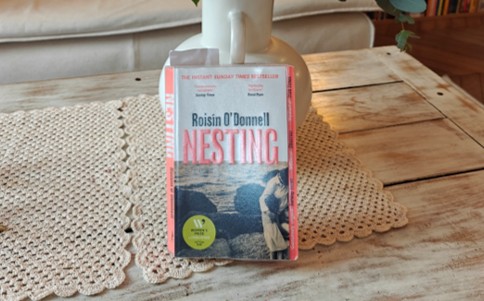
Nesting by Roisín O’Donnell

I haven’t yet recovered from Nesting, Roisín O’Donnell‘s fantastic debut novel. It still sits in my chest, not yet digested.

In a few words, Nesting is the story of Ciara Fay, mother of two, pregnant with a third, who decides one day to leave her controlling husband.

From the first scene, as he insists on taking the girls swimming in the freezing sea, we follow Ciara’s precarious balancing act – indulging him, protecting them – and it’s impossible not to root for her.

O’Donnell masterfully executes the “escape” – we have no choice but to feverishly turn the pages, hoping they make it, that he doesn’t catch them. By the time they fall asleep in the car, surrounded by nature, and wake up in the morning mist, we are so invested that it is very clear this novel will be devoured.

The language humbly serves the main character and the story, but in several places it is clear that it is also worth reading for its own sake. This is after all the story of a woman reclaiming her voice, an English teacher who travelled the world before waking up one day married, pregnant, and stuck in a very small world.
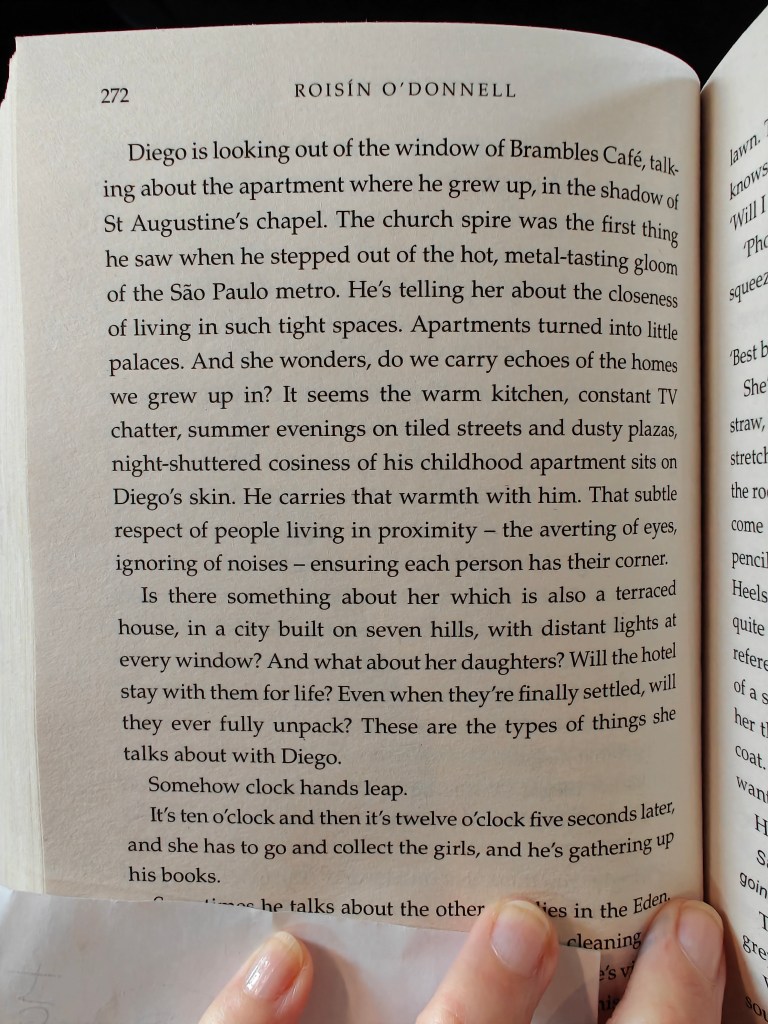
Nesting extract

That small world is treated with immense dignity. All the little tasks of motherhood, the struggles of parenting with very little money, of rebuilding a home in a hotel room, are rendered with rough immediacy, without ever tipping over into voyeuristic miserabilism.

The characters that enter and expand Ciara’s world in the “Eden” hotel all feel real. So do her relationships with her mother and sister, and each obstacle she needs to overcome. The husband is perhaps too one dimensional at times – almost as if rather than being a proper character, he was a representation of something bigger and rather ugly.

The theme of birds is nicely weaved into the story. The lone crow symbolising both the husband’s ferocity and Ciara’s emancipation. Sophie’s fierce insistence on holding the falcon. Ciara’s mother’s knowledge of birds and their songs. It offers Nesting a coherent imagery, without ever feeling heavy handed.

I have read this book quickly – in the train, before bed, waiting in line in the bathroom. Needing to reach that final page, to know what would happen to them in the end. I know I will read it again eventually, to fully appreciate the care and craft that went into it.

Finally, in a world where AI likes to pretend it can fill our inspiration cup like real authors can, I very much appreciated O’Donnell’s final dedication. It matters to me that she cares, and I can’t wait to read everything else she writes.

To anyone trapped in a place that does not feel like home, to anyone who has ever been asked the question, why don’t you just leave, this one’s for you.

Assembly by Natasha Brown – a quiet Howl

Natasha Brown’s debut novel Assembly packs a punch with just 100 pages of prose clear and sharp as crystal about what it’s like to be Black and British.

So, when that mouth opened up and coughed its vitriol at her, making some at the table a little uncomfortable, she understood the source of its anger, despite being the target. She waited for the buzz of her phone to excuse her and – in the meantime – quietly, politely, she understood him.

In many respects Assembly reads like a quiet, repressed Howl – Allen Ginsberg’s famous poem which howled all in one breath what it was like to be othered in an America.

Brown’s prose is very close to poetry, crossing the formal line many times, like on page 30:

So come on now. Lift left foot and swing it ahead, spring forward. Don’t slow down, don’t stop. Don’t think. Just keep it moving.

Go get on the train.

But here I am,
still
stood, still
at the station.
I really should

The narrator’s nihilistic detachment is framed straight away. Where authors usually dedicate the book to their loved ones, she writes:

This too is meaningless,
a chasing after the wind.

But she has fire in her. There are so many delicious eviscerations in the book but Lou’s was my absolute favourite:

Back at the office, Lou’s not in yet. He rarely shows up before eleven. As if each morning, fresh mediocrity slides out of the ocean, slimes its way over mossy rocks and sand, then sprouts skittering appendages that stretch and morph and twist into limbs as it forges on inland until finally, fully formed, Lou! strolls into the lobby on two flat feet in shined shoes.

So why doesn’t she scream, why doesn’t she stand up to the bullies, why doesn’t she howl? Well *gestures at systemic racism around us* that’s why. On page 56, Brown writes:

Explain air.
Convince a sceptic. Prove it’s there. Prove what can’t be seen.

So Assembly is also a demonstration, through anecdotes that seem cartoonish sometimes (she’s a senior leader but expected to make the coffees and book others’ airplane tickets) but that I suspect are, like in Atwood’s The Handmaid’s Tale, all true. Why invent when reality provides so many exhibits.

There are also actual exhibits in Assembly, demonstrating how Black British people are both othered and asked to “quietly, politely understand”. These exhibits are actually formatted as illustrations in a textbook – “Fig 1.”, “Fig 2.” – and give snippets of the thousand cuts bringing the proverbial death. For those, she uses the subject “you” to pull the reader in: you get harassed and can’t say a thing, passed in the queue and asked to “keep the noise down”, and you realise with horror that even howling is white privilege.

Throughout the novel, the narrator talks about her cancer diagnosis, and her decision to let is spread – her refusal to fight it. It’s hard not to think that it’s the result of / the metaphor for that repressed howl.

The ending is subtle. A half-arsed marriage proposal, her suspended answer. In my opinion it came too soon – because I loved Brown’s writing, but also because I’ve been groomed to believe that all heroines should get their revenge. I half-hoped for a Dogville ending: burn the stolen generational wealth, at least figuratively!

But that was not the project. Brown had announced “This too is meaningless” at the very beginning. Hundreds of years of history, thousands of daily cuts prove she’s most likely right. But with her 100 pages, she makes the reader want to howl on her behalf – and that is not meaningless.

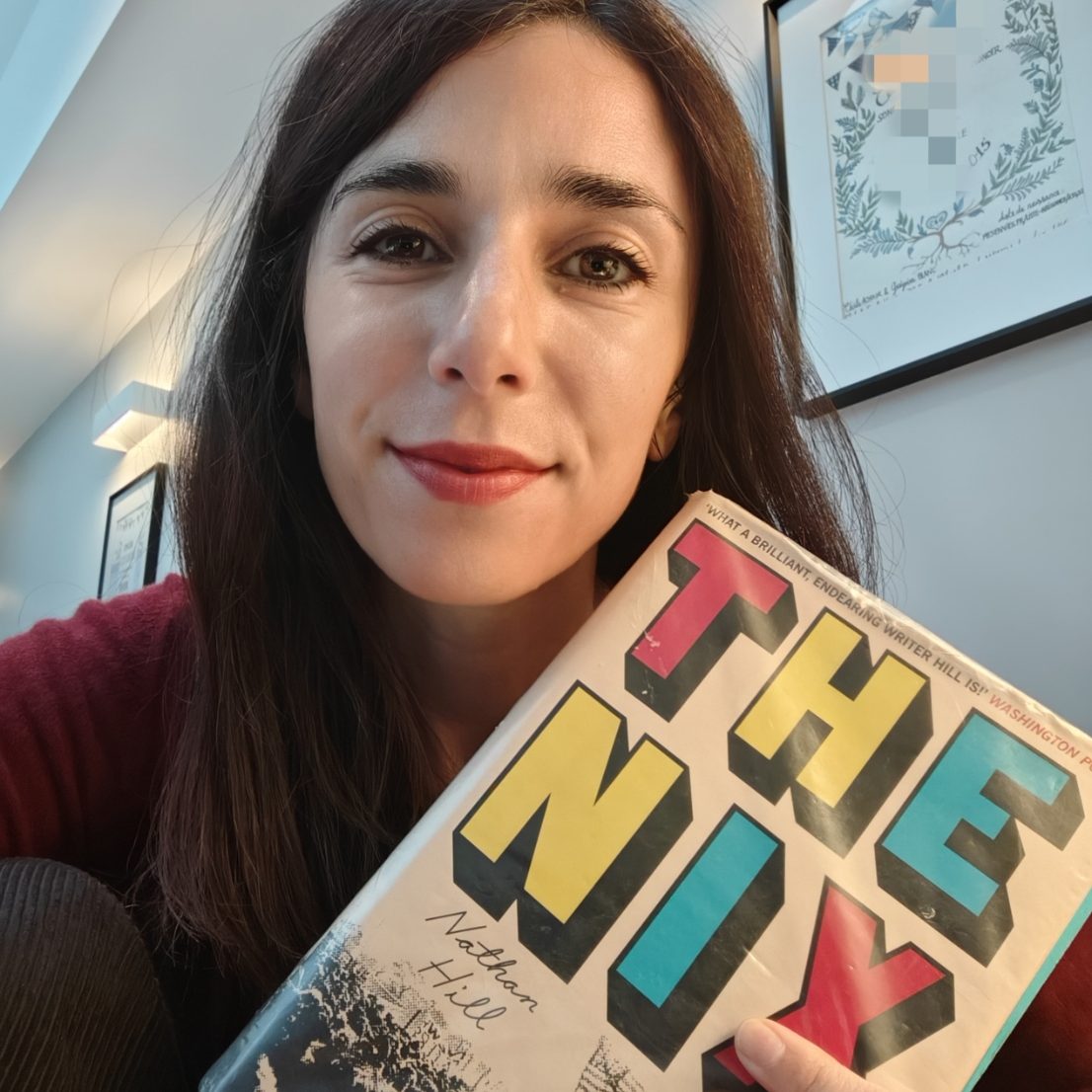
Book Review – The Nix by Nathan Hill

I ordered The Nix from my library after a friend recommended it this summer, and fell in love with the voice straight away: erudite and witty, with the best prologue I have read in a while, and a devastating first sentence:

If Samuel had known his mother was leaving, he might have paid more attention.

The prose in Nathan Hill’s impressive debut novel is sneaky. The language is delicious and reads easily. Humour softens us up. Then daggers are planted deep in our hearts.

As a mother of boys, I find the chronic misunderstanding between the main character Samuel and his mother triggering – and cried like a baby at the end of the first chapter of Part Two:

“And I told you to bring nine toys,” she said. “You brought eight. Next time try to pay more attention.” And the disappointment in her voice made him cry even harder, so that he couldn’t talk, and thus he couldn’t tell her that he put eight toys in the wagon because the ninth toy was the wagon itself.

The story starts when the mother becomes a viral sensation for throwing rocks at a presidential candidate, and the son she abandoned as a child is coerced by his publisher into writing a sensational ‘tell-all’ book about her. As he investigates her past, family secrets are unveiled and old wounds are healed.

It’s a book from a decade ago, but very relevant to today’s tired gender wars, where men and women are expected to keep competing in a never-ending zero sum game where the only winners are those who fan the flames of outrage for social media engagement – and even traditional publishers like The New York Times and The Guardian are taking the (click-)bait.

This makes reading Nathan Hill’s novel now all the more poignant, and imbues the turtle anecdote – which I can’t resist sharing here – with new meaning: perhaps we can emulate Samuel’s journey and build new bridges, rather than widening the gap generation after generation.

Years later, in a high-school biology class, Samuel heard a story about a certain kind of African turtle that swam across the ocean to lay its eggs in South America. Scientists could find no reason for the enormous trip. Why did the turtles do it? The leading theory was that they began doing it eons ago, when South America and Africa were still locked together. Back then, only a river might have separated the continents, and the turtles laid their eggs on the river’s far bank. But then the continents began drifting apart, and the river widened by about an inch per year, which would have been invisible to the turtles. So they kept going to the same spot, the far bank of the river, each generation swimming a tiny bit farther than the last one, and after a hundred million years of this, the river had become an ocean, and yet the turtles never noticed.

Book Review – Orbital by Samantha Harvey

In short: it seems to me that Booker 2024 winner Orbital started as an impactful short story and was a bit overstretched.

The premise was powerful: an astronaut’s mother dies while she is stranded on the International Space Station. We follow her musings as she orbits in contemplative loops above continents and oceans.

They look down and they understand why it’s called Mother Earth. They all feel it from time to time. They all make an association between the earth and a mother, and this in turn makes them feel like children.

The treatment is ethereal and repetitive, which plays beautifully into the low gravity, orbital state of the ISS.

My main frustration is the same one I have with Malick’s Tree of Life. In the words of actor Sean Penn: “A clearer and more conventional narrative would have helped the film without, in my opinion, lessening its beauty and its impact.

Similarly, Orbital is full of beautiful imagery, and devoid of any plot.

I love all things ISS (the International Space Station). There is a Lego replica of it above my bed. Sometimes when my faith in humanity wobbles, I rewatch the 5min intro to the movie Valerian, showing the first Soviet and American stations joining up, followed by many others modules from around the world, to the sound of David Bowie’s Space Oddity. I was the perfect reader for this book, and yet found it laborious to finish.

What I liked

Harvey plays with the clichés of nurturing, cyclical womanhood and transcending, linear manhood, to subvert them. In many ways this book is the antithesis to Tom Wolfe’s The Right Stuff, which was all about manly manhood in space conquest.

The Earth here is often compared to a woman – not just a mother but a lover also, which traps these explorers into her orbit, hypnotises them…

You could abandon it all, just to look. You could never comprehend the stars, but the earth you could know in the way you know another person, in the way he came quite studiedly and determinedly to know his wife. With a yearning that’s hungry and selfish. He wishes to know it, inch by inch.

… and alienates them from their “natural” sun-centric cycle, to elevate them to an earth-centric, infinite loop where they will be bound to pause and reflect.

They cling to their twenty-four hour clock because it’s all the feeble little time-bound body knows – sleep and bowels and all that is leashed to it. But the mind goes free within the first week.

This opposition between harsh “nature” and elevated “grace” is also at the heart of The Tree of Life, personified respectively by the father and the mother.

But Harvey subvert these tropes. She puts the following words in the mouth of a man:

Man’s hubris. A hubris so almighty it’s matched only by its stupidity. And these phallic ships thrust into space are surely the most hubristic of them all, the totems of a species gone mad with self-love.

And these in the mouth of a woman:

He asked her then if she’d ever go to Mars, knowing the journey would be at least three years and that she might never come back. Yes, she’d answered without a moment’s hesitation, and it was hard for her to understand why anyone would choose otherwise.

Harvey makes this duality – nature vs grace, alpha vs omega, yearning vs contentment, exploration vs contemplation – a tension that lives within us all, rather than a man vs woman dichotomy, which I found well done and refreshing.

What I didn’t like

As mentioned above, beyond the initial idea of one of the astronaut losing her mother while being on the ISS, the narrative threads from the other astronauts/cosmonauts felt flimsy.

In particular, the friendship between one of the astronauts and a Filipino fisherman felt to me like the kind of material you’d see in an advert for an energy company, with a gently non-comital baseline like “For all humanity”.

It could have been done in a fresh and believable way but was instead full of clichés of first-world / third-world embrace. This sentence in particular was frankly uncomfortable to read:

What of the Filipino children he and his wife met on their honeymoon, the fisherman’s children? Their easy toothy grins, the scuffed rough knees and silken skin, their vests and flip-flops and dirty toes, their sing-song chatter, the bottomless brown of their lovely eyes (…)

The paragraph continues in the same vein, mentioning the astronaut’s “nice-smelling” wife. Close to the end of the book, this sentence shattered for me any attempt at universality, and left a bad taste in my mouth.

In summary

It was still a nice read. I would recommend finding a moment to read it all in one go (it is only 136 pages).

It is a Booker winner for a reason. Some of the language, especially when painting our blue planet, is sublime.

There is a tiny random sentence I keep thinking about:

The Nile is a spillage of royal-blue ink.

It seems to me like a lovely little “wink” from the god-like, world-building writer.