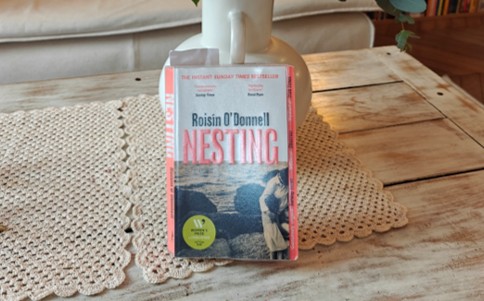
I haven’t yet recovered from Nesting, Roisín O’Donnell‘s fantastic debut novel. It still sits in my chest, not yet digested.
In a few words, Nesting is the story of Ciara Fay, mother of two, pregnant with a third, who decides one day to leave her controlling husband.
From the first scene, as he insists on taking the girls swimming in the freezing sea, we follow Ciara’s precarious balancing act – indulging him, protecting them – and it’s impossible not to root for her.
O’Donnell masterfully executes the “escape” – we have no choice but to feverishly turn the pages, hoping they make it, that he doesn’t catch them. By the time they fall asleep in the car, surrounded by nature, and wake up in the morning mist, we are so invested that it is very clear this novel will be devoured.
The language humbly serves the main character and the story, but in several places it is clear that it is also worth reading for its own sake. This is after all the story of a woman reclaiming her voice, an English teacher who travelled the world before waking up one day married, pregnant, and stuck in a very small world.
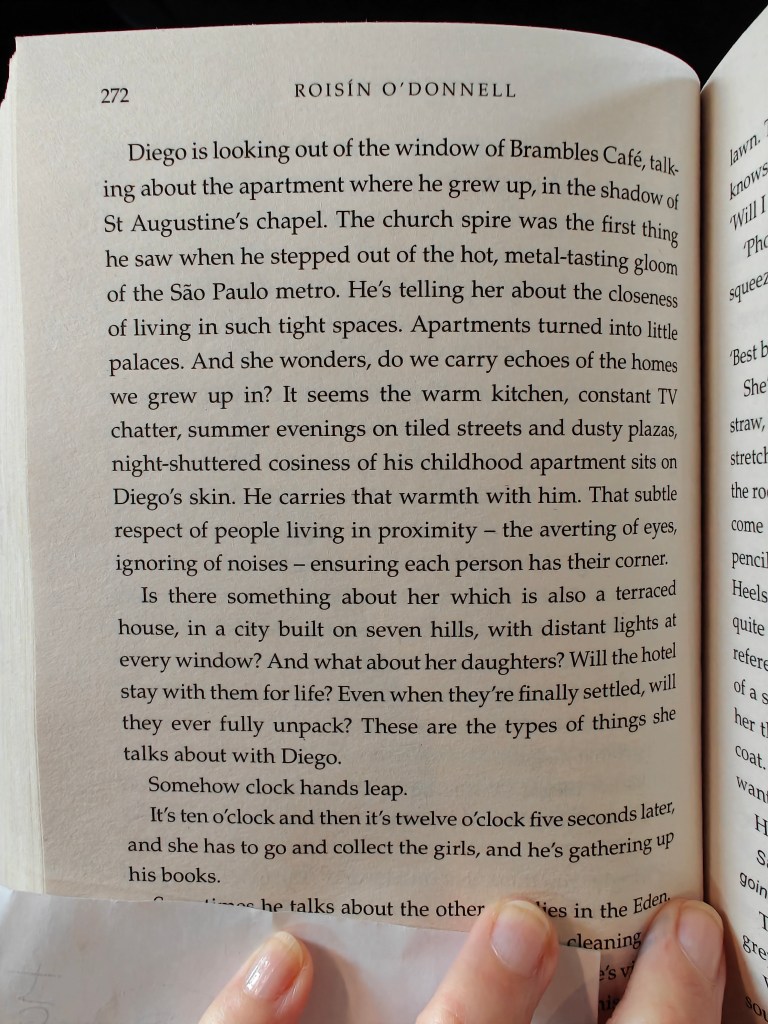
That small world is treated with immense dignity. All the little tasks of motherhood, the struggles of parenting with very little money, of rebuilding a home in a hotel room, are rendered with rough immediacy, without ever tipping over into voyeuristic miserabilism.
The characters that enter and expand Ciara’s world in the “Eden” hotel all feel real. So do her relationships with her mother and sister, and each obstacle she needs to overcome. The husband is perhaps too one dimensional at times – almost as if rather than being a proper character, he was a representation of something bigger and rather ugly.
The theme of birds is nicely weaved into the story. The lone crow symbolising both the husband’s ferocity and Ciara’s emancipation. Sophie’s fierce insistence on holding the falcon. Ciara’s mother’s knowledge of birds and their songs. It offers Nesting a coherent imagery, without ever feeling heavy handed.
I have read this book quickly – in the train, before bed, waiting in line in the bathroom. Needing to reach that final page, to know what would happen to them in the end. I know I will read it again eventually, to fully appreciate the care and craft that went into it.
Finally, in a world where AI likes to pretend it can fill our inspiration cup like real authors can, I very much appreciated O’Donnell’s final dedication. It matters to me that she cares, and I can’t wait to read everything else she writes.
“To anyone trapped in a place that does not feel like home, to anyone who has ever been asked the question, why don’t you just leave, this one’s for you.“

